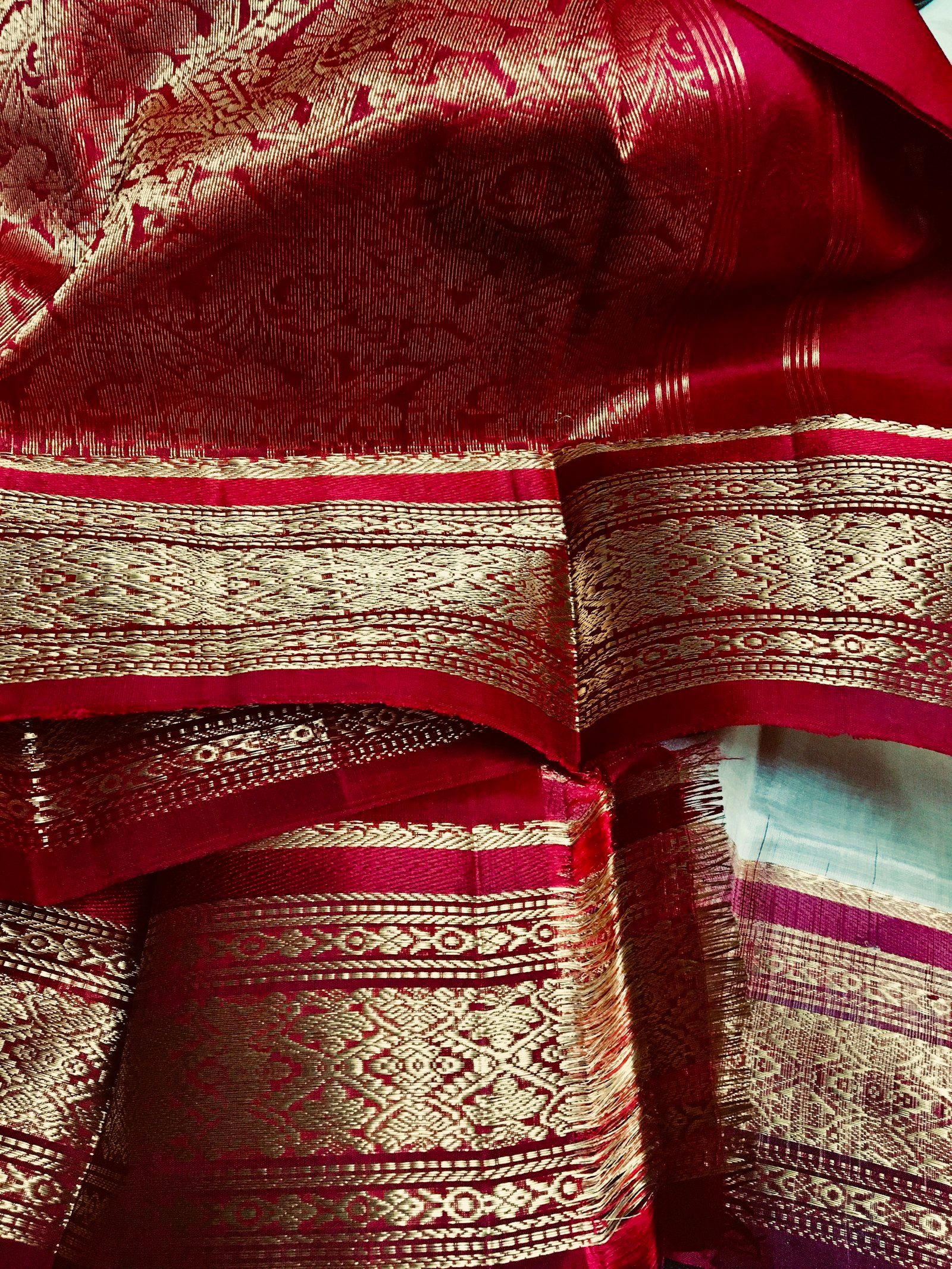
Madhya Pradesh's two great handloom traditions are often confused. Both are silk-cotton, both come from temple towns, both have GI protection — but the differences are clear once you know what to look for.
Origin and lineage
Chanderi traces to the 13th century in Chanderi town, with patronage from the Bundela rajputs and later the Mughals. Maheshwari is younger — its modern form was personally commissioned by Rani Ahilyabai Holkar of Maheshwar in 1767.
The body
Chanderi is famously sheer and translucent — you should see light through it. Maheshwari is denser, with a slightly heavier hand and a matte finish (less sheen than Chanderi).
The pallu
This is the easiest tell. Chanderi pallus carry isolated zari butis on a plain ground. Maheshwari pallus have five distinct stripes alternating in colour — a feature you won't find in any other Indian saree.
The border
Chanderi borders are typically narrow with zari butis. Maheshwari borders are reversible — the saree can be worn either way up — and often feature a contrasting "leheriya" wave or check pattern.
Which to buy
For sheer-light summer wear or pastel celebrations, choose Chanderi. For something with more body that drapes structured pleats and works in mild winter, choose Maheshwari. Price-wise they overlap heavily — both start around ₹4,000 and rise to ₹30,000+ for richer pieces.