History & patronage.
The town of Chanderi sits on a sandstone ridge between the Betwa and Sindh rivers, ringed by the forts of the Bundela kings. The first written record of cloth from this town comes from the 11th century — a court chronicle that lists "Chanderi muslin" among the gifts sent to the Khilji court at Delhi.
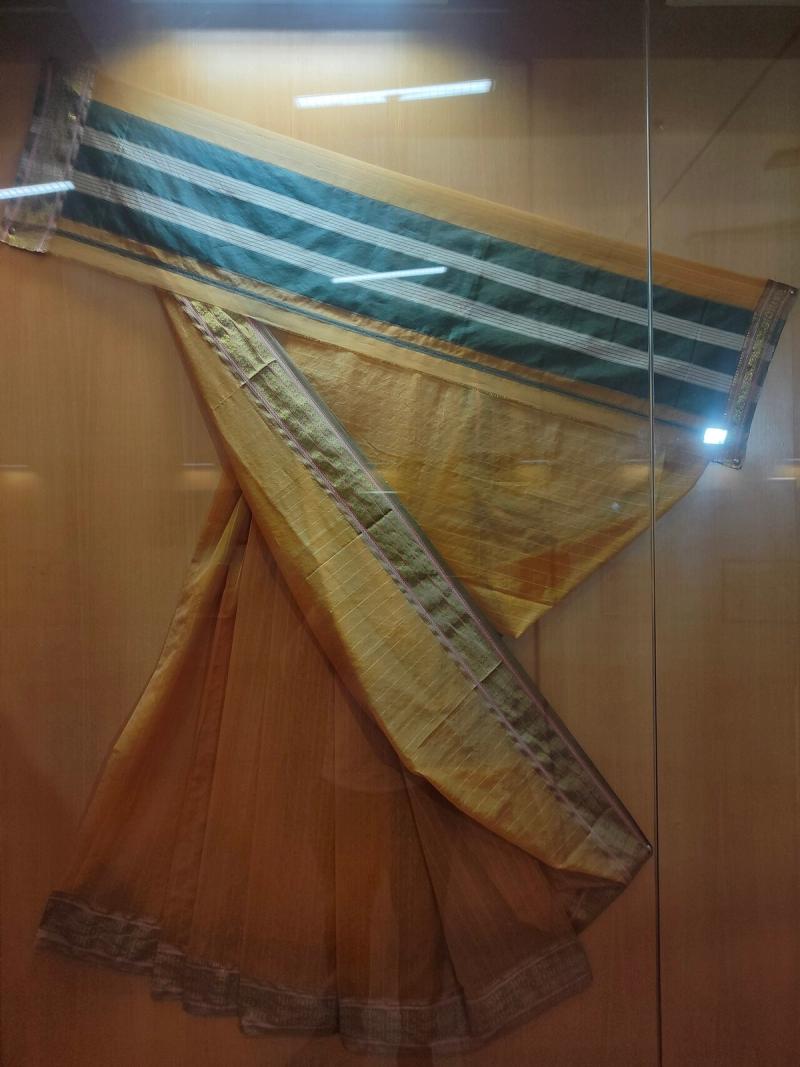
By the Mughal era, Chanderi was woven exclusively for royal households. The textile was so highly regarded that the Mughal court demanded an annual tribute of Chanderi sarees from the local Bundela rulers — a tax paid in cloth, not gold.
"There is no muslin in the empire to equal that of Chanderi — a fabric so fine it can be drawn through a finger-ring, yet so strong it will hold a clasp of zari without tearing."<span class="attribution">— Abul Fazl, Ain-i-Akbari, c.1590</span>
The decline began with the East India Company's textile blockades in the 19th century and accelerated after Independence when industrial polyester flooded the market. Today, fewer than 3,500 active weavers remain in the town — a small, GI-protected community now slowly rebuilding direct-to-consumer trade.
The loom & the cloth.
A Chanderi is woven on a horizontal pit loom — a sunken bench with two foot pedals, a wooden beater, and a dobby attachment for the butis. The weaver sits with their legs in the pit, working the warp threads with one hand and beating the weft with the other.
The signature translucency comes from a single trick: the warp uses unscoured single-ply silk — silk that still has its natural sericin coating intact. Most silk is washed (scoured) before weaving to remove sericin, but Chanderi weavers leave it on. The result is a yarn that glimmers in soft light and resists drape-collapse.
How a buti is made.
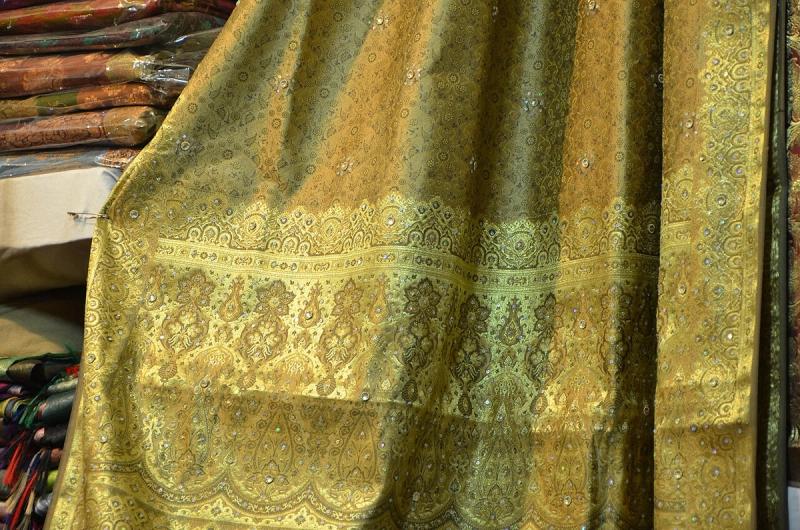
The butis (small repeating motifs scattered across the body) are added by an extra-weft technique. Where the design calls for a buti, an extra thread of gold or silver zari is woven between the regular warp and weft, lifted by the dobby attachment, and cut clean on the reverse.
A single buti — say, an asharfi coin — takes about 90 seconds to weave. A saree with 240 butis takes six hours of motif-weaving alone, on top of the 60+ hours of plain ground weaving.
Motifs you'll see.
How to spot a real one.
- 01 Light Hold the body against bright sunlight. A real Chanderi is translucent enough to read newsprint through; a power-loom imitation is opaque.
- 02 Reverse Flip the saree and look at the reverse of the zari butis. Hand-woven Chanderi shows clean cut threads; machine-made versions have flat backsides with no visible cut.
- 03 Weight A six-yard hand-woven Chanderi weighs 350–500 g. If it feels close to 1 kg, you're looking at silk-replacement viscose with metallic film, not real zari.
- 04 Sound Crush a small portion between your palms and release. Real silk-cotton makes a soft "krish" sound; synthetics make none.
- 05 GI Every authentic Chanderi sold through Madhya Pradesh's Hastashilp Vikas Nigam carries a holographic GI tag with a unique serial number — verifiable at the official MPHSVN portal.
Where to buy direct.
Living with it.
- Store rolled, never folded
- Folds at the same line for months produce permanent creases — the silk fibres at the crease break. Roll loosely around a cotton or muslin tube.
- Air, don't wash
- Sun-air after each wear. Dry-clean rarely — every 4–6 wears at most. Washing weakens the zari and dulls the sericin sheen.
- Avoid direct perfume contact
- Alcohol-based fragrances darken zari over time. Apply perfume before draping, never after.
- Re-fold along a new line every six months
- Even rolled, the saree settles. Re-roll along a different starting edge twice a year to distribute wear evenly.