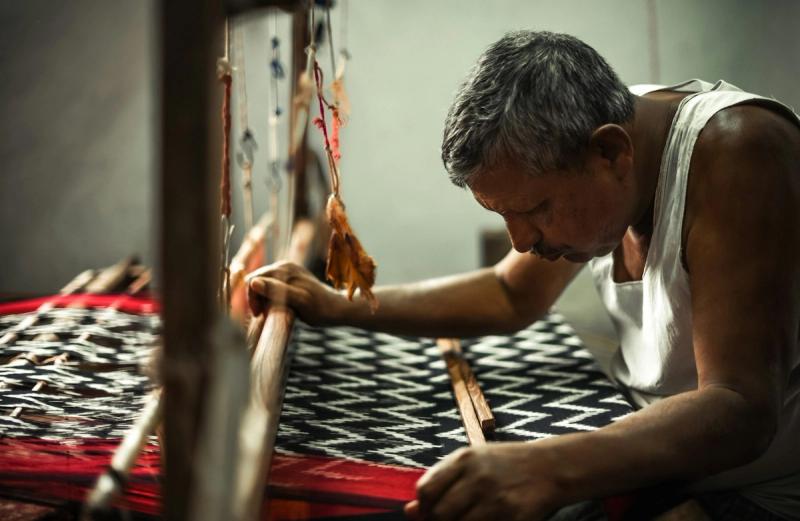
Eight hundred years of the Salvi loom.
Patan Patola is among the most labour-intensive textiles ever made. It was woven for the courts of Gujarat's Solanki dynasty in the 12th century, and later traded across the Indian Ocean — Patola silks have been excavated from medieval Egyptian tombs and Indonesian royal collections.
Today, just three Salvi families in Patan, Gujarat, weave true Patan Patola — the same families who have held the craft for sixteen generations. Demand far exceeds supply; the waiting list runs into years.
Double ikat, by hand.
The Patola technique is double ikat: both the warp and the weft are tied off and dyed in pattern, before the cloth is woven. Each yarn passes through the dye bath up to ten times for different colours, with thousands of resist-knots tied between dye rounds.
A single Patola saree takes six months to a year on a manual loom, with two weavers working in coordination — one passing the shuttle, one aligning the pattern. The motifs (elephants, dancing women, flowers, geometric grids) appear identical on both sides of the cloth because the pattern is dyed into the thread itself.
How to spot a real one.
- 01 Both sides identical A true double-ikat Patola shows the same motif on the front and back with no "right side". Single-ikat imitations have a clear face and a duller reverse.
- 02 Salvi signature Genuine Patan Patola carries the Salvi family's GI-registered handloom mark and is sold only from their workshop or through the GI registry-approved channels.
- 03 Edge fuzz Pre-dyed yarns leave tiny coloured fuzz along the selvedge where the resist knots were trimmed. Machine-printed imitations have crisp edges.
- 04 Hand pattern alignment Look for small, deliberate misalignments in the motifs — a hallmark of hand-woven double ikat. Perfectly geometric patterns are printed, not woven.
- 05 Price floor A genuine Patola starts around ₹1.5 lakh and rises into the multi-lakh range. Anything below ₹40,000 is almost certainly single-ikat Rajkot Patola, not Patan.
Living with it.
- Dry-clean only with a silk specialist
- The natural dyes (madder, indigo, turmeric, harda) bleed if washed at home. Use a master silk cleaner.
- Wrap in muslin
- Store rolled (not folded) in cotton mulmul. Silk-cotton interaction protects the natural dyes.
- No sunlight
- Direct sun fades madder and turmeric within hours. Store in a closed, dark cupboard.
- Insurance
- A Patola is a serious investment. Most owners insure them under a household textiles rider.