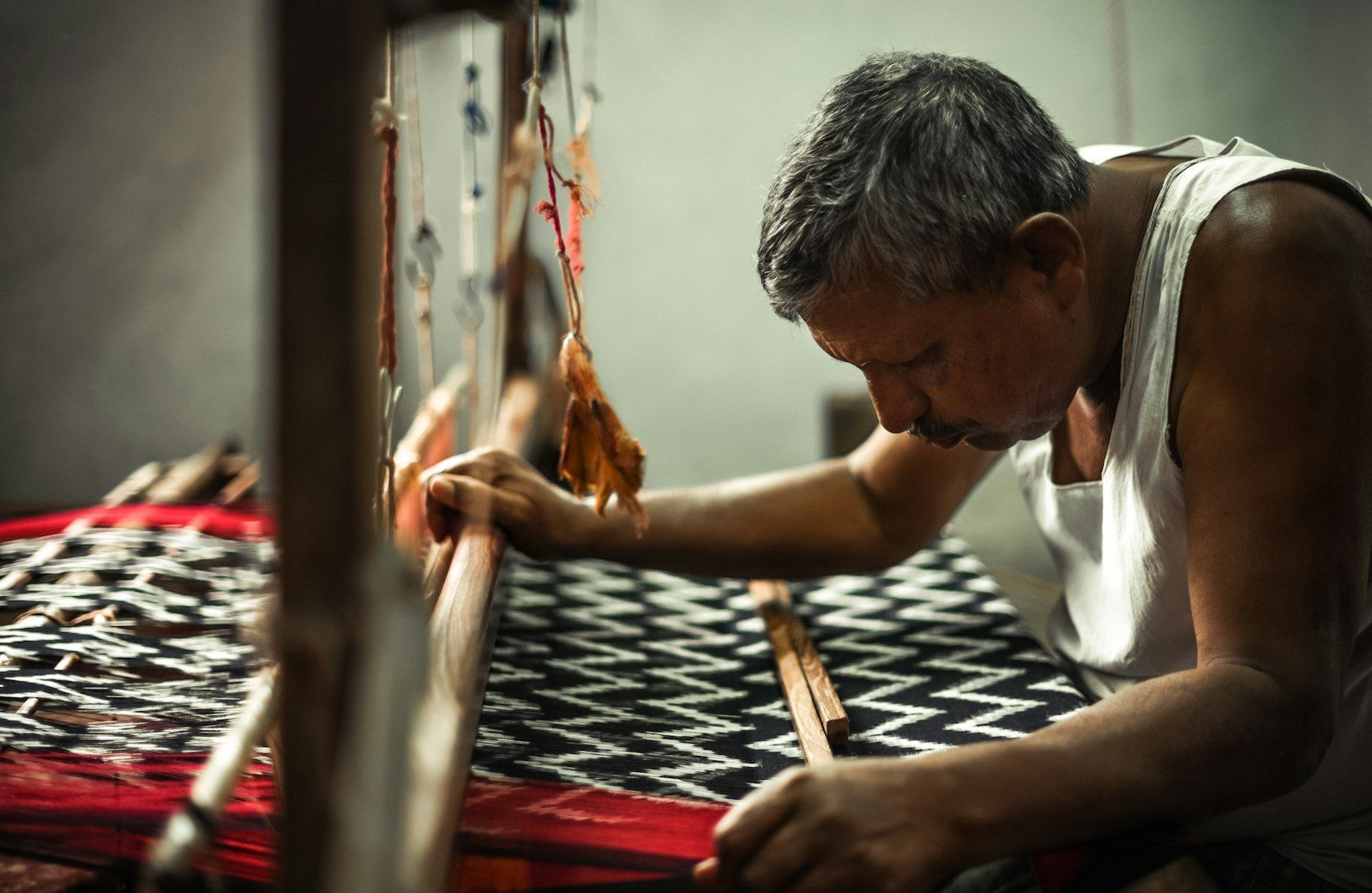
If you've ever been told a saree is "handloom" and nodded along without quite knowing what it meant, you're in the right place. The word gets used as a mark of quality, a price justification, and a cultural badge — often all at once. This guide strips it back to what it actually means, how a handloom saree comes to exist, and what to look for when someone hands you one.
What "handloom" actually means
A handloom is a loom worked entirely by a person — no electric motor, no automation. The weaver throws the shuttle that carries the crosswise thread, presses the pedals that lift and lower the lengthwise threads, and beats each row of weave into place by hand. The cloth advances at the speed of human hands and judgement.
That is the whole distinction. A handloom saree is woven on such a loom. A powerloom saree is woven on a loom driven by an electric motor, which throws the shuttle mechanically and weaves many times faster. (We compare the two in detail in Handloom vs Powerloom.) Everything people associate with handloom — the slight irregularity, the weight, the way it drapes, the price — flows from that one fact: a person made it, pick by pick.
Handloom weaving in India is overwhelmingly a household craft — practised at home, often across a whole family and passed down generations, and one of the country's largest sources of rural non-farm livelihood. The Fourth All India Handloom Census (2019–20) counted around 35 lakh handloom workers — roughly 26.7 lakh weavers and 8.5 lakh allied workers — across about 31.4 lakh households, the overwhelming majority rural, and more than 70% of them women.
How a handloom saree is made
A finished saree hides an enormous amount of preparation. Broadly, the journey runs through six stages:
- Yarn selection — the weaver chooses the fibre: cotton, silk, wool, or a blend. The fibre decides almost everything downstream — the weight, the sheen, the season the saree suits.
- Dyeing — the yarn is coloured before it ever reaches the loom, often in small batches. Many traditions still use natural dyes; most today use colour-fast synthetic dyes, washed and dried over several cycles so the colour holds.
- Warping — the lengthwise threads (the warp) are measured out — often hundreds of them, many metres long — and wound under even tension. Slow, exacting work, because every later thread depends on the warp being true.
- Loom setup — the warp is mounted and each thread drawn through the healds and the reed. A single saree's warp can mean thousands of threads individually threaded by hand before a single row is woven.
- Weaving — the weaver throws the shuttle carrying the crosswise thread (the weft) from side to side, lifts and lowers sets of warp threads to lock each pick in place, and beats it down. Patterned borders and the pallu may need extra shuttles, an extra set of warp threads, or a draw-loom mechanism — which is why an ornate saree takes far longer than a plain one. A simple handloom saree might come off the loom in a few days; an intricate silk can take weeks or months.
- Finishing — the woven saree is cut from the loom, washed to remove the sizing, then stretched, dried, and pressed. Final hand-work tidies the borders and the pallu.
The takeaway for a buyer: by the time a handloom saree reaches you, dozens of skilled hours sit inside it. That is the real story behind the price.
Handloom, powerloom, and mill — the quick version
Three words get muddled. Handloom is human-powered. Powerloom is the same basic weaving process driven by an electric motor — much faster, far more uniform. Mill (or "millmade") cloth is fully industrial, mass-produced fabric. None of these is "fake" — but only handloom carries the hand-made character, the livelihood, and the heritage that this site is about. If telling them apart matters to you, read Handloom vs Powerloom next.
How to recognise a handloom saree
You don't need to be an expert. A handful of checks, done by hand, get you most of the way:
- Look at the reverse. Handwoven sarees usually show the working threads on the back — loose ends, floats of zari where motifs were tied off. A flat, identical reverse suggests a machine.
- Find the little irregularities. Tiny slubs, a motif that varies by a hair, a border that isn't laser-perfect — these are signatures of a human hand, not flaws.
- Feel the weight and the drape. Handloom cloth tends to have body and falls in a soft, living way. Many powerloom imitations feel thin, slick, or stiff.
- Watch the price. A saree that looks richly woven but costs suspiciously little is almost certainly not handloom.
Weave-specific checks go deeper — see, for example, how to spot an authentic Chanderi or how to identify a genuine Banarasi.
Why handloom matters
- Livelihoods. Handloom is among India's largest rural employers after agriculture, and a rare craft where skill, not capital, is the main asset. Buying handloom keeps that economy alive.
- Heritage. Each tradition encodes centuries of regional technique — a Jamdani is not a Paithani is not a Patola. Lose the weavers and you lose the knowledge.
- Authenticity protection. Many handloom traditions are protected by a Geographical Indication (GI) tag, a legal mark tying a name to its place of origin. What that does and doesn't guarantee is worth understanding — see Understanding GI Tags.
The great handloom sarees of India
India's handloom map runs from the silks of the south to the muslins of the east to the tie-dyes of the west. A few to start with:
- Banarasi — opulent silk brocade from Varanasi
- Kanjivaram — heavy temple silk from Tamil Nadu
- Chanderi — sheer silk-cotton from Madhya Pradesh
- Jamdani — figured muslin from Bengal
- Paithani — peacock-bordered silk from Maharashtra
- Patola — double-ikat from Gujarat
That's barely the beginning. Browse the full field guide to India's weaves, or explore where each one comes from.
Frequently asked questions
Is a handloom saree better than a powerloom one?
"Better" depends on what you want. Handloom gives you hand-made character, breathability, drape, and a direct line to a weaving tradition and the people who keep it alive. Powerloom gives you a lower price and perfect uniformity. For an heirloom, an occasion, or to support weavers, handloom wins. For an everyday budget piece, powerloom is honest value — as long as it's sold as what it is.
Are handloom sarees expensive?
They span a huge range. A simple handloom cotton can cost a few thousand rupees; a fine silk with rich zari work runs into lakhs. The price reflects the fibre and the days of skilled labour inside it.
How long does it take to weave one?
Anywhere from a couple of days for a plain saree to several weeks or months for an intricate silk.
How do I care for a handloom saree?
Gently — most silks prefer dry cleaning, and all handlooms like to be stored folded with breathing room and refolded along new lines periodically. See our practical handbook on caring for silk sarees.
How do I actually wear it?
There are far more than one way. Start with a beginner's guide to Indian saree drapes.